Proof of conversion is the new KPI.
Agents that remember
every buyer.
IntellQ runs six agents between your website and every visitor. They read intent from behaviour, remember every visitor, lead and customer, start from what worked for businesses like yours, change only the parts of the page you marked, and keep a change only when it beats a control group.
No card. One script tag. 7 days free, then USD 79 a month with unlimited seats.
- Readerintent
- Memoryrecall, learn
- Strategistbandit
- Guardianpolicy
- ActuatorDOM slots
- Experimenterholdout
- readervisitor 4f2c, session 3, read ingredients block 41s, cart twice checkout_recovery 0.72
- memoryopened sealed memory: lead since 12 Sep, declined offer.v1
- memoryindustry pool: skincare and beauty, counts only, own share left out prior ready
- strategistranked 3 strategies, offer.v1 skipped for this person, picked reassure.v1
- AES 256 GCM
- every memory sealed at rest
- 1 key
- per workspace, derived, never stored
- 0
- IP addresses stored
- 20%
- held out as control by default
The agents
Six agents. One visit. Every decision on the record.
Each agent does one job and hands the visit to the next, inside the 2.5 second budget of the request your tag already makes. Each one is code you can read in the console trace: what it saw, what it chose, and why.
Reader
Turns a visit into intent.
Seconds per page block, scroll, return visits, cart and checkout depth. Every signal decays with a 48 hour half life, then the visit lands in one of seven contexts such as checkout_recovery or pricing_friction.
Strategist
Picks the one change worth trying.
A contextual bandit scores every allowed strategy on prior fit, a Beta posterior, lift over control and an exploration bonus that shrinks with evidence. It starts from your industry's evidence and moves to yours.
Guardian
Says no more often than yes.
Six autonomy levels, your guardrails, risk tiers, cooldowns and consent are checked on every decision. The kill switch is honoured on the next request, and every refusal is written down with its reason.
Actuator
Touches only what you marked.
Four operations on elements carrying data-intellq-slot: set text, show, hide, or point a link at a page on the same site. Text goes in through textContent, so a change is never markup or script.
Experimenter
Proves it, or undoes it.
Holds 20 percent back as control, buckets each visitor with a SHA-256 hash so they stay in one arm, credits each conversion to one exposure once, promotes winners and rolls back losers on its own.
Agent memory
The longer they run, the better they get. And they start ahead.
Most website tools forget a visitor the moment the tab closes and start every new customer from nothing. IntellQ's agents keep three layers of memory and decide from all three on every visit.
Layer 1
Every person
One memory per visitor, lead and customer. Their stage, what they responded to, and every strategy they turned down, which the agents never show them again. A customer is not chased with the offer that won them.
Layer 2
Your business
The Conversion Genome: the journeys your buyers walk, where they stall, which blocks they read, which strategies worked here and which failed. Rebuilt every night from the last thirty days.
Layer 3
Your industry
Behaviour patterns pooled across businesses that sell what you sell, as counts. A brand that joins today starts on what moved buyers at brands like it, not from zero.
The pattern travels. The data does not.
A skincare brand installs IntellQ today. Its agents have no buyers of their own yet, but other skincare brands have already taught theirs which strategies move a hesitant checkout and how buyers in this category move between product, cart and checkout. The new brand starts there. None of those brands' pages, customers or memory come with it.
and every other brand in the industry
Industry pool: skincare and beauty
Counts only. Rebuilt every night.
- checkout_recoveryreassure.v1 converts 11.0%, control 10.0%
- pricing_frictionclarify.v1 converts 6.4%, control 5.1%
- journeyproduct > cart > checkout
- repeat_evaluationconverts 3.8%
illustrative figures
New skincare brand, day one
First change it proposes
Reassure at checkout, because that is what moved checkout visitors at brands like it.
industry weight fades as its own visitors arrive
Crosses between brands
- How many visitors in each context saw each strategy, converted, or reacted badly
- Journeys as page roles: product, cart, checkout, never a URL
- How each context converts, as a count of visitors and converters
Never crosses
- Any visitor, lead or customer, or their memory
- Pages, URLs, copy, slot names, offers, event names, traffic sources
- Your Conversion Genome, your experiments, your numbers as yours
- 3 businesses
- minimum in a pool before any agent reads it, so no single brand can be read out of it
- Your share left out
- an agent reads its industry minus its own contribution, never its own numbers echoed back
- 40 visitors
- the most the whole industry counts for per strategy, so a brand's own evidence takes over fast
Sealed
A database dump reads as noise.
Every memory is sealed before it is stored, with a key that exists only for your workspace. The record is bound to the workspace and the person it belongs to, so copying it anywhere else gives nothing back.
- 1
secret
held in the deployment, not the database
- 2
HKDF SHA-256
one derived key per workspace
- 3
AES 256 GCM
random IV, authenticated
- 4
bound
to workspace and person
In the console
Read, propose, prove, remember
Four steps, and the screen each one happens on.
- 1
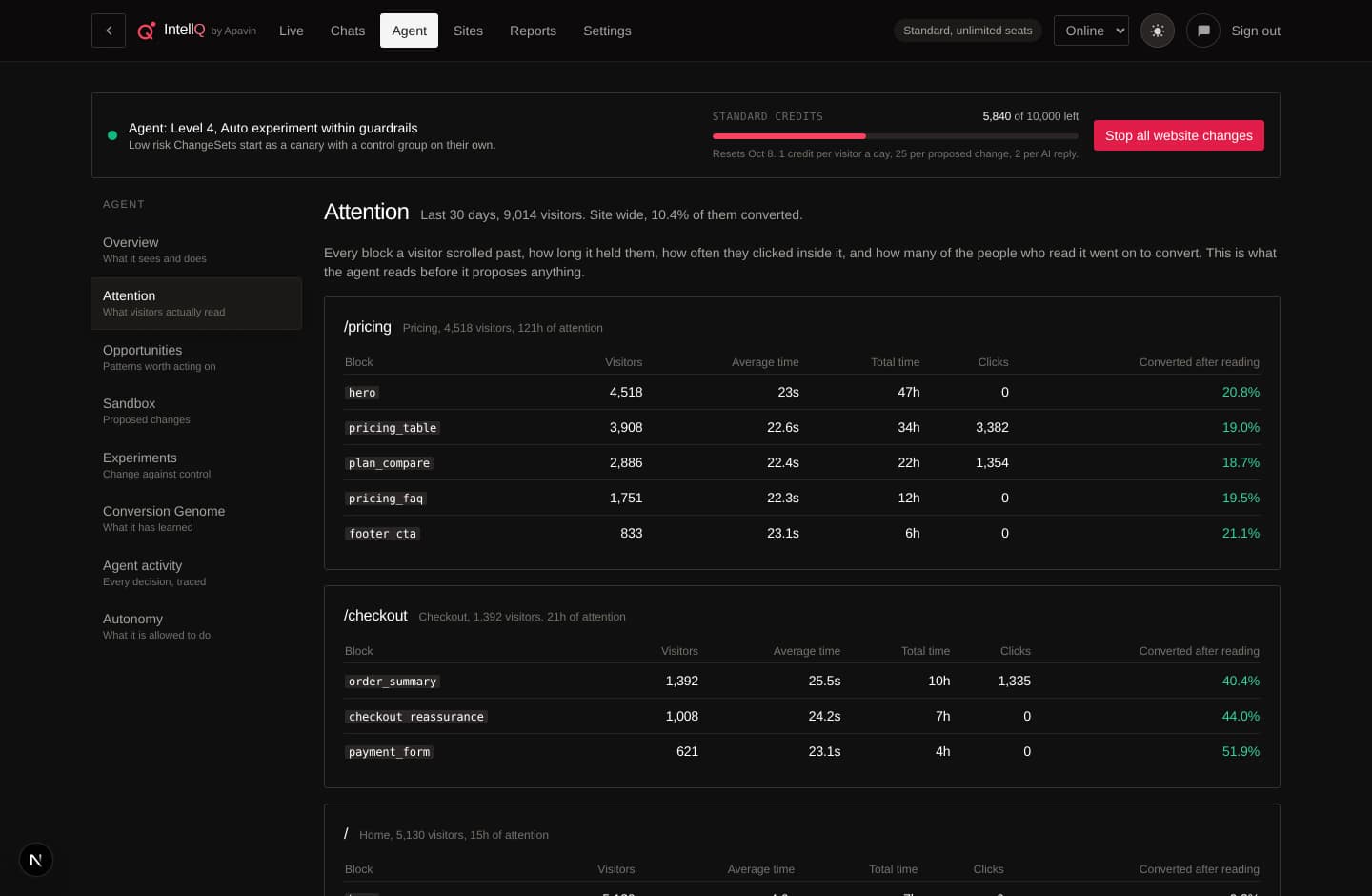
It reads the visit
Pages, referrer, campaign, scroll, dwell, and the blocks that actually held attention. Recent behaviour counts more than old: every signal decays with a 48 hour half life, so three pricing views this afternoon are evidence and three last month are a whisper.
- 2
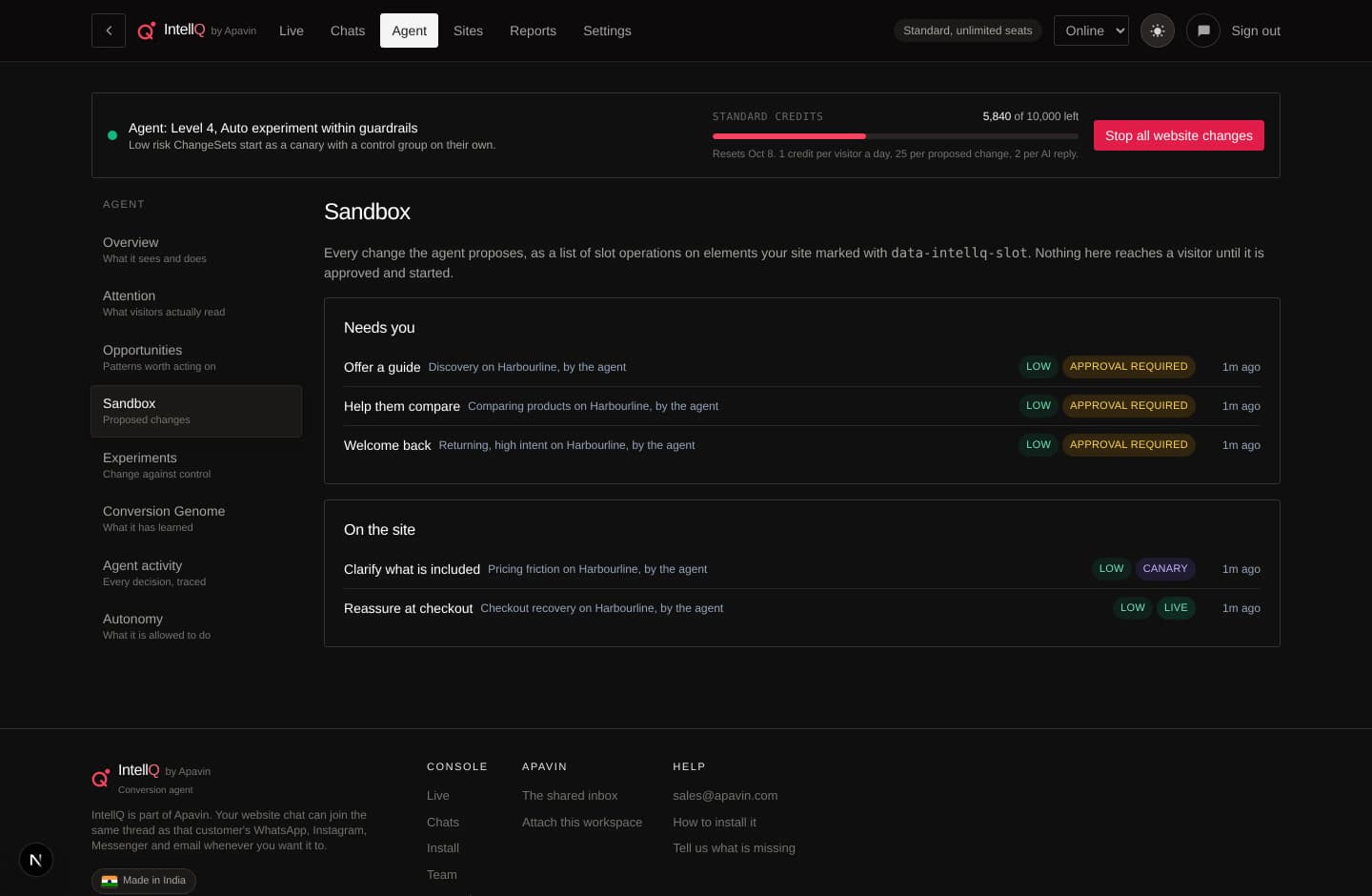
It proposes one change
When a context has enough visitors behind it, the agent writes a bounded ChangeSet against slots you marked, with the hypothesis, the evidence and the expected outcome attached. You see it in a sandbox preview in your own browser before a visitor ever does.
- 3
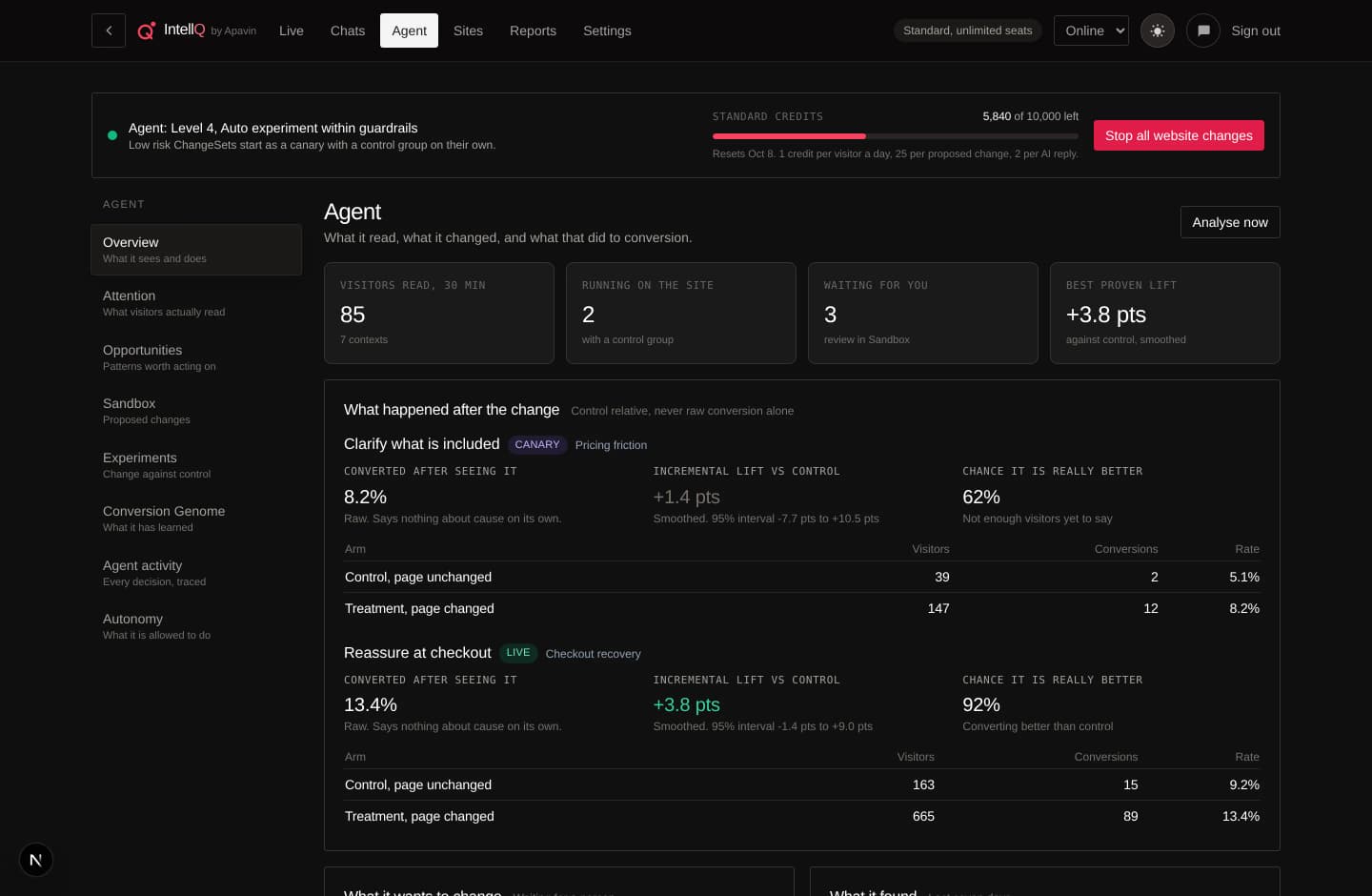
It proves it against control
Approved changes go out as a canary with a control group held back. Assignment is a stable hash, so a visitor stays in the same arm. A conversion is attributed to the last exposure inside the window, once, never twice.
- 4
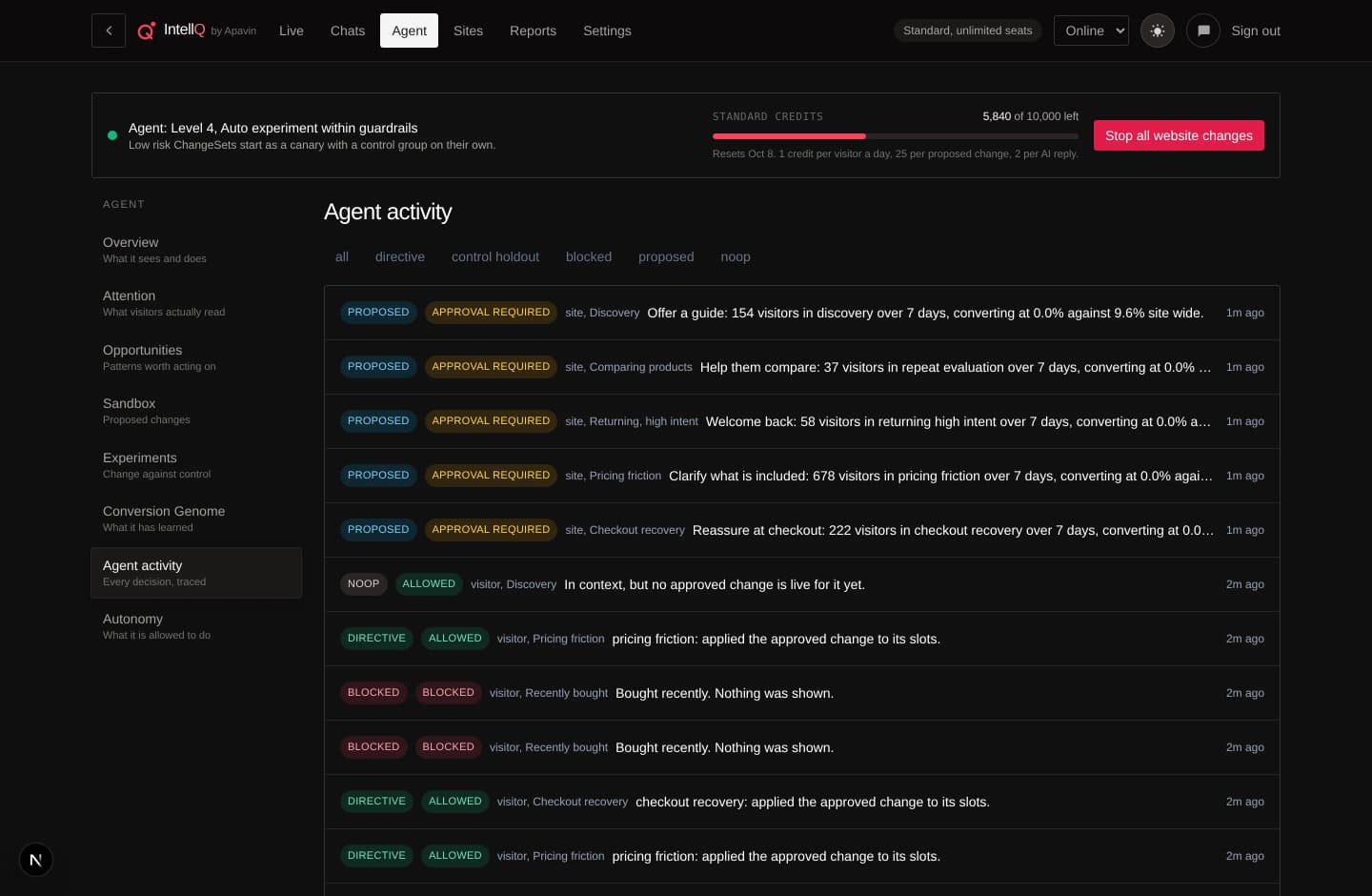
It keeps, rolls back, and remembers
Better than control and past the minimum sample: promoted. Worse: rolled back on its own and recorded as a negative outcome, which makes that strategy less likely to be chosen here again. Either way the result goes into memory: the person's, the business's and, as a count, the industry's.
<script src="https://www.intellq.in/intellq.js"
        data-key="iq_your_site_key" async></script>

<p data-intellq-slot="pricing_reassurance">Simple pricing.</p>
One tag, and a slot attribute on anything you are willing to let the agents rewrite. Nothing without that attribute can be touched.
The proof
Lift against a control group, or it does not count
Conversion after a change is not evidence the change caused it. Every experiment holds a control group back, and the console shows the raw rate and the lift over control side by side, labelled, so one is never sold as the other.
Control
9.2%
15 of 163
Treatment
13.4%
89 of 665
Lift
+3.8 pts
92% chance it is really better
Demo workspace, the change called “Reassure at checkout” in checkout recovery. The second change on that site is still marked not enough visitors yet to say, which is the agents refusing to call a winner early.
Autonomy is a dial, not a leap
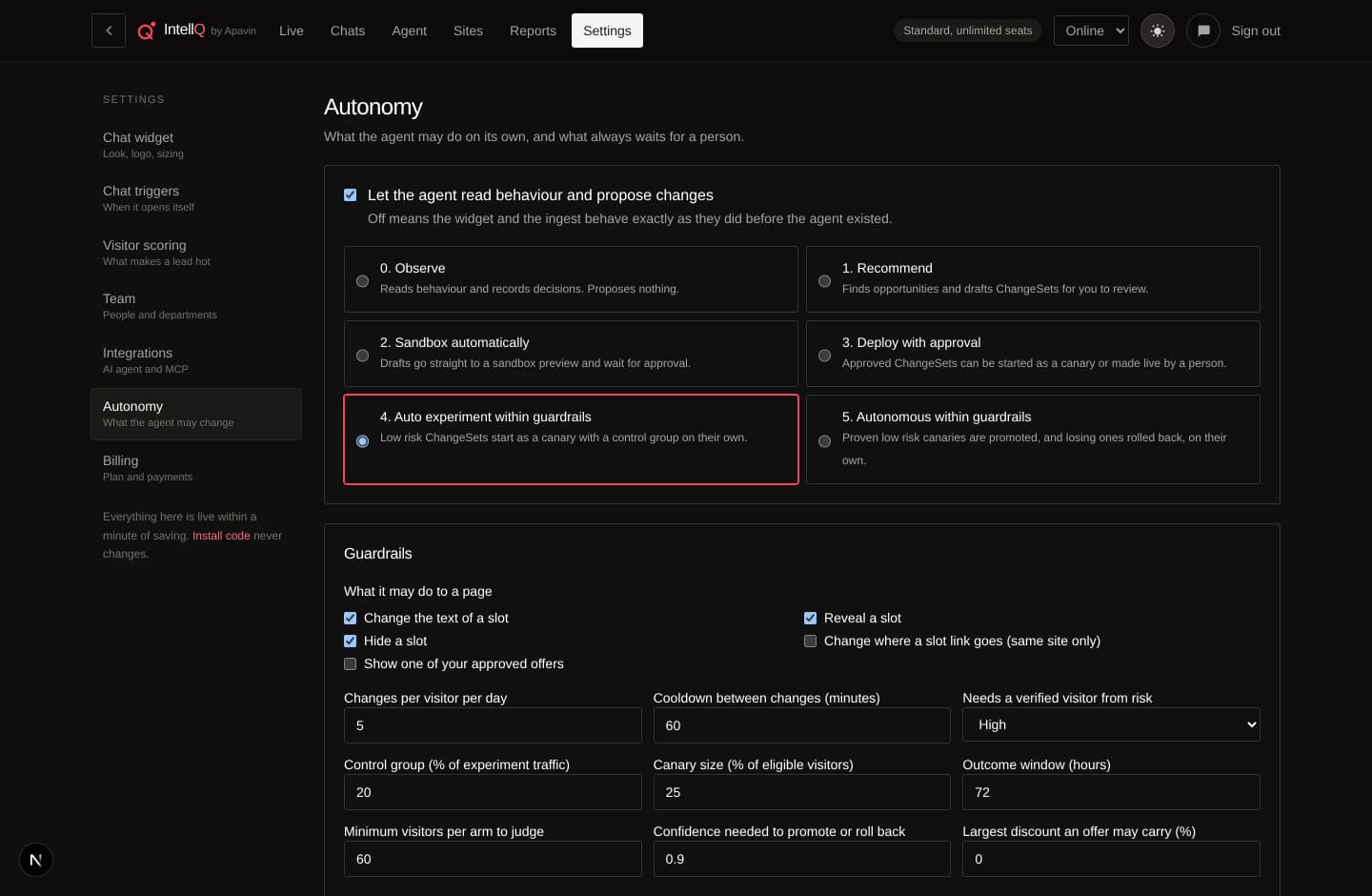
Level 0 watches. Level 1 recommends. Level 2 builds a sandbox. Level 3 deploys what a person approved. Level 4 runs its own experiments inside your guardrails. Level 5 promotes and rolls back on its own. One button stops every live change on the next request, and nothing is deleted when it does.
Pricing
Seats are free. Agent work is metered.
Every plan has unlimited operator seats. What is metered is the agents: 1 credit per visitor they read and decide on, at most once per visitor per day, and 25 per change they propose. Tracking, the live board and reports are free.
Standard
Most bought$79a month
10,000 agent credits
For a site with real traffic and a team on it
Choose StandardWhen credits run out the agents stop deciding and every live change stops being served. Tracking, reports and your website carry on as before, nothing is deleted, and memory picks up where it left off when the period resets. Full pricing
Questions people ask first
What is IntellQ?+
IntellQ by Apavin is a set of conversion agents that sit between your website and each visitor. They read intent from behaviour, remember every visitor, lead and customer, learn from businesses in the same industry, change only the page elements you marked, and keep a change only if it beats a holdout control group. It is built by Apavin in India and starts free.
What does the agent remember?+
Three layers. Each person it has met: whether they are a visitor, a lead or a customer, what they responded to, and any strategy they turned down, which it never shows them again. This business: the Conversion Genome of journeys, frictions, attention and which strategies worked, rebuilt every night. And businesses like this one: behaviour patterns pooled across an industry, as counts only.
If a new skincare brand joins, does it get other brands' data?+
No. It gets the pattern, not the data. Every brand's memory stays sealed in its own workspace. What joins the industry pool is counts: how many visitors in each context saw each strategy and converted, journeys as page roles such as product then cart then checkout, and how each context converts. No pages, copy, offers, event names, customers or memory ever cross. A pool is used only once three other businesses are in it, a brand reads it minus its own share, and the whole industry counts for at most 40 visitors per strategy, so a brand's own evidence takes over quickly. Contributing can be switched off per workspace.
How is agent memory encrypted?+
Every memory the agents write is sealed with AES 256 GCM before it reaches the database: visitor, lead and customer memory, the Conversion Genome, each workspace's contribution to its industry pool and the pool itself. Each workspace has its own key, derived with HKDF from a secret held in the deployment environment and never stored. Each sealed record is bound to its workspace and the person it belongs to, so a row copied into another workspace does not open.
What does the IntellQ agent actually do?+
It reads how every visitor behaves on your website, including which blocks of a page held their attention, and puts them in a context such as pricing friction or checkout recovery. When a context has enough visitors behind it, it writes a bounded change to the page, shows it to you in a sandbox, runs it against a control group that sees the page unchanged, and keeps it only if the treatment converted better. Anything that converts worse is rolled back.
Can it change anything on my site?+
No. It can change the text of a slot you marked with data-intellq-slot, show or hide one, or point one at another page on the same site. That is the whole list. It cannot inject markup, run script, load anything from another domain, or touch an element you did not mark. The browser code matches slots by attribute rather than by a selector it built, and it writes text with textContent, so a change is text and never markup.
How does it learn from heatmaps and blocks?+
The script watches each block of the page with an IntersectionObserver and counts the seconds it was at least half on screen while the tab was in front, plus clicks inside it. One event per page, at most twelve blocks. Nothing is read from inside a block: no text, no field values, no cursor tracks, no session replay. That gives a heatmap of attention per block, which the agent uses to tell a page somebody read from one they scrolled past.
How do credits work?+
A credit is one unit of agent work. 1 credit is one visitor read and decided on, charged at most once per visitor per day. 25 credits is one proposed change, written with its evidence and a sandbox preview. Tracking, the live board and reports cost nothing. When the credits run out the agent stops deciding and your website carries on unchanged.
How much does IntellQ cost?+
Free is 7 days with 5,000 credits and no card. Standard is USD 79 a month with 10,000 credits. Pro is USD 139 a month with 100,000 credits. Operator seats are unlimited on every plan and are never counted for billing.
Will it deploy something to my site without asking?+
Only if you set it to. Autonomy runs from level 0, where it only observes, to level 5, where it acts inside your guardrails on its own. At level 3 and below every change waits for a person to approve it. The kill switch stops every live change on the next request, and nothing is deleted when it does.
Does IntellQ store IP addresses?+
No. Country, region and city come from the CDN's own headers, and the IP is never written to the database. Visitor identity is never inferred from an IP either: a visitor counts as identified only when your own site signs an assertion with the key for that site.
What does the agent measure a change against?+
A control group that is held out of every experiment and sees the page unchanged. The console shows the raw rate after the change and the control relative lift side by side, labelled, so the first can never be read as the second. Below the minimum sample per arm it refuses to call a winner and says so.
Where does IntellQ sit in my stack?+
In the request path between your website and the visitor. The tag streams events to the IntellQ runtime, and the decision for that page comes back on the same response inside a 2.5 second budget. Nothing proxies your HTML and nothing sits in front of your origin: the agent only changes slots you marked, in the browser, after your page has rendered.
Does the agent use an LLM?+
Not to decide what your visitors see. Strategy choice is a contextual UCB bandit over your own traffic, warm started from your industry's pooled counts, so every decision can be traced to the numbers behind it. No language model writes page content.
Does IntellQ include live chat and an AI chat agent?+
Yes, under one Chat tab: an inbox for your team, a widget you size per device, proactive triggers, and an AI agent that answers from your own knowledge on your own model key, calls your tools over MCP, and hands over to a person for orders and payments. The console chimes the moment a visitor starts a chat.
How is this different from an A/B testing tool?+
An A/B testing tool waits for you to have the idea, build the variant and read the result. IntellQ finds the pattern, writes the variant, runs the experiment, reads the result and rolls back its own losers. You approve or you do not.
Proof of conversion is the new KPI.
Watch the agents work on your own site.
A call with the founder: your traffic, the contexts your visitors fall into, and the first change the agents would propose.